
India will require a total investment of $10.1 trillion to achieve net-zero emissions by 2070, while the nation could face a shortfall of $3.5 trillion, a study by CEEW Centre for Energy Finance (CEEW-CEF) said. At the recently concluded COP26, Prime Minister Narendra Modi announced India's aim to achieve net-zero emissions by 2070. "India would need cumulative investments of $10.1 trillion to achieve net-zero emissions by 2070, according to an independent study released today by the CEEW Centre for Energy Finance (CEEW-CEF)," a statement said.

Reserve Bank of India Governor Shaktikanta Das on Friday said the central bank will ensure adequate liquidity in the system to ease the financial stress caused by the Covid-19 pandemic. The central bank reduced the reverse repo rate -- the rate at which banks park their fund with the central bank -- by 25 basis points to 3.75 per cent.

The speed at which he led the central bank in different areas -- ranging from internal reorganisation to inflation fighting, stabilising the currency, taking on rogue corporations, cleaning up bank balance sheets, and opening the sector -- makes one believe that Rajan knew he had only three years to do his job. A fascinating excerpt from Tamal Bandyopadhyay's MUST-READ Roller Coaster: An Affair with Banking.

Some believe the shift to mobile-based transactions will be seamless considering that the urban tele-density is 148%. In rural areas, it is touching 51%. But smartphone penetration in India is a mere 12%. Growth of mobile money has been extremely slow: It is currently 1%.
For the first time in our economic history a government has thought about more than 50 per cent of our economic activity instead of the five per cent represented by the Sensex companies, observes IIM-B professor R Vaidyanathan.

The 15-member body called for enhanced actions, from closing financial system loopholes to stopping the abuse of charitable causes, as well as updating the existing IS and Al Qaeda sanctions list.

The venture is applying to the Reserve Bank of India for approvals.

'If the RBI had done the right things, these mistakes would not have happened in banks, public or private,' says Ajay Shah.

Modi knew in his heart that India does not have the financial muscle to support the new bank with offers of co-financing international projects, something China can do from the bank's base in Shanghai. If established in Mumbai, it may have employed a few Indian bankers and satisfied the national ego but there was little financial value to be drawn from it.
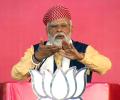
Modi's BJP has promised more revdis or freebies for these assembly elections than ever before, points out N Sathiya Moorthy.

The venture is seen as a rival to the World Bank.

'In a serious fiscal situation like this, an ostrich-like focus on annual budgeting, event management and defensive rhetoric will only make matters worse,' warns Rathin Roy.

Once these banks start showing losses, they will not be able to pay dividends to the government nor pay taxes, which will further aggravate the situation for the government as its return on investment as an investor would be very negligible for the next few years, says M V Subramanian.

'The shadow banks are currently facing a liquidity and solvency crisis.' 'The danger is that it could potentially engulf the entire financial system because shadow banks have borrowed huge amount of money from banks, mutual funds, pension funds, and insurance companies.'
SBI, PNB, Bank of Baroda, Canara Bank, Dena Bank, Central Bank of India ended down 3%-12% each.
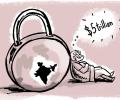
It would be a difficult task for the Indian economy to reach the $5-trillion mark a year before the International Monetary Fund (IMF) projection of 2026-27. Pankaj Chaudhary, minister of state for finance, said in the Rajya Sabha on Tuesday that the government is taking steps to make the country a $5-trillion economy at a date earlier than the IMF's projection. In that context, it would not be difficult to meet the projection in the third quarter of FY27.

Norms governing investments by provident funds bar these from depositing funds in a commercial bank in case the NPAs of that bank exceed two per cent of net advances.

'The entire value of LIC is created by its shareholders because after the initial invest net of Rs 5 crores in 1956, the government has not given any additional capital to the LIC.' 'If the corporation has expanded and emerged as the biggest financial institution in the country, it is only because of the policyholders.'

Investors are pushing back more often against companies' resolutions on what is paid out to top executives. In the first four months of financial year 2022-23 (FY23), there have already been five such rejections, according to shareholder voting data from tracker Adrian, a platform maintained by the proxy advisory firm Institutional Investor Advisory Services India (IiAS). Two of these have been at multiplex chain PVR and direct-to-home company Dish TV India.

The central bank held 72.5 per cent equity in Nabard worth Rs 1,450 crore, of which 71.5 per cent amounting to Rs 1,430 crore were divested way back in October 2010 and the residual shareholding was divested on February 26, 2019.
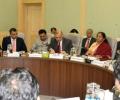
At a pre-Budget meeting, the FM was asked to ensure that NBFCs come out of the liquidity crisis they are facing with the help of RBI. They also spoke about the futility of trying to achieve a 3 per cent fiscal deficit target over the medium term.

After his wide-ranging talks with Modi on the second and final day of his India visit, Johnson said the new defence and security partnership will enable India to strengthen its domestic defence industry as well as help the two countries protect vital shared interests in the Indo-Pacific.

There was a massive 24% decline in India's gems and jewelry exports to $2,321 million for September 2018 as against $3,053.38 million in the same period last year.
Most forecasts do not have a track record of transparency and accuracy

'Zero Day' visitors like Maruti Suzuki, TVS, Tata Motors, Hero MotoCorp, Ashok Leyland and Bajaj Electricals are visiting fewer campuses.

After a hiatus of nearly two decades, the government's programme to privatise state-owned firms restarted with the handing over of debt-laden national carrier Air India to the Tata Group. With the new owner shelling out Rs 18,000 crore for the buyout of the 'Maharaja', this would be the highest-ever amount garnered through privatisation, and is even more than the cumulative sum mopped up through strategic sales from 1999-00 to 2003-04. The government had in October last year inked the share purchase agreement with the Tata Group for sale of national carrier Air India for Rs 18,000 crore. Tatas would pay Rs 2,700 crore cash and take over Rs 15,300 crore of the airline's debt.

'When the average growth in the last three years was just 2.5%, how does that make us the fastest growing country?' 'They only tell you what has happened in the last 2 years; they are not taking into account what happened in FY21 on account of their mistakes.'

'80% of the rural and urban population don't have enough purchasing power.'

The board meeting is likely to take place later in Shanghai.
.jpg)
With new private banks in the play, the going could become more difficult for the old-school state-run banks, already losing business and market position, forcing them to think hard towards consolidating and forming larger entities to garner big-ticket deals.

Will G20 showcase an India that is inclusive, culturally rich, diverse and tolerant, asks Ramesh Menon.

In the midst of third wave of COVID-19, Finance Minister Nirmala Sitharaman has come up with an impactful Budget which is balanced, fiscally prudent and growth-oriented, the USA India Chamber of Commerce has said. President of the Boston-based USA India Chamber of Commerce (USAIC) Karun Rishi, however, said it is a matter of concern that the budget lacks tangible measures to increase revenue generation. "Opting to keep the fiscal deficit at 6.9 per cent and increase capital expenditure by 35 per cent is a masterstroke. "The annual budget estimates the effective capital expenditure of Rs 10.68 lakh crore in 2022-23, making up about 4.1 per cent of the GDP," he said. "A phenomenal increase in the government's capital expenditure is likely to facilitate the expenditures on infrastructure and create jobs.

Lack of financial commitments from rich countries poses threat to Paris meet

'LIC's proposed investment will come out of what is technically called the 'policyholders funds'.' 'As the name implies, these monies belong to policyholders; that is, you, me and 25 crore others who have taken a total of 30 crore policies from LIC.' 'It is not the government's or LIC's money to play poker with,' says S Muralidharan, former managing director, BNP Paribas.
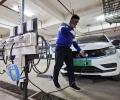
New Delhi's timing couldn't have been worse, both for India's fledgling electric vehicle (EV) sector and prospective electric bike buyers. It was hard to miss the perfect storm brewing for India's EV industry since early 2022. On one hand, you had several accidents involving battery fires that unnerved consumers; on the other, uncertainty had crept in over subsidies.

'In plain simple English, these practices amount to a looting of our country's future by some in the business community, in cahoots with some lenders,' says RBI Governor Dr Urjit R Patel.

With the new owner shelling out Rs 18,000 crore for the buyout of 'Maharaja' this would be the highest ever amount garnered through privatisation or even the cumulative sum garnered through strategic sale in 1999-00 to 2003-04. The government had garnered roughly over Rs 5,000 crore during that five-year period by privatising 10 CPSEs.

Indian regulators have identified certain groups as 'financial conglomerates' and they are being monitored closely for any systemic risks they may pose.
One can expect significant changes at India's banks in ensuing months.

RBI governor Raghuram Rajan and the government are working towards financial inclusion.
